


AI, Engineers, and the Zero to One Illusion

Introduction
Recently, an engineer asked me whether AI-generated code should be trusted “as is” or reviewed with the same rigor we apply to human-written code, especially when the pull request spans ten pages. It’s a fair question, and one that reflects a broader shift in how we think about software development in the age of AI. At the same time, I keep seeing headlines predicting the extinction of programming as a profession. Articles celebrate so-called 10x individuals who have built apps using AI without any prior programming experience. Nvidia’s CEO even suggested that children shouldn’t be taught to code because AI will eventually handle it, and that we should focus instead on domain expertise and prompting skills.
With all this buzz, it wouldn’t be surprising if some leaders start to believe that AI will turn every engineer into a 10x contributor — and that, therefore, we only need a tenth of the engineers we once did. It’s in this context that I found myself thinking about Peter Thiel’s book Zero to One, and wondering: Are we truly at a Zero to One moment with AI, or are we still just moving from One to N?
Zero to One Framework
In his book, Zero to One, Peter Thiel highlights the most significant advancements that come from building products and services that didn’t exist before, representing the zero to one leap, rather than copying existing products. Thiel argues that building monopolies through radical innovation is crucial for capturing value and driving progress. He explores strategies for creating these unique businesses by focusing on proprietary technology, network effects, economies of scale, and strong branding.
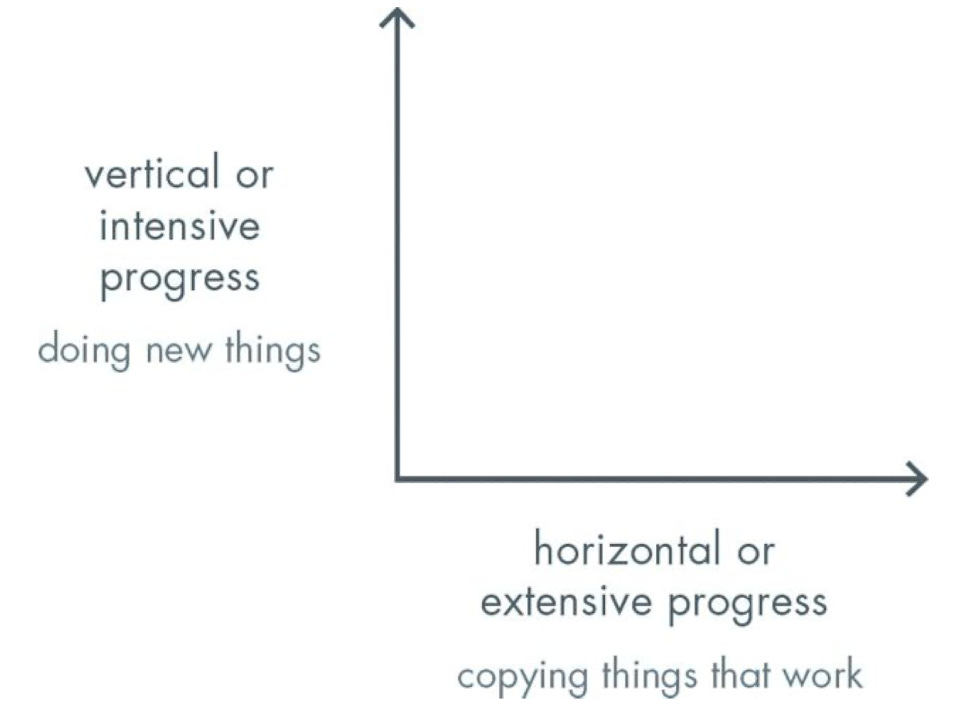
According to Thiel, vertical progress through technology and breakthroughs is far more valuable than horizontal progress such as globalization and scaling what already works. The book encourages entrepreneurs to think boldly and create new markets rather than competing in existing ones. Some examples of zero to one innovations include, iPhone, which redefined a phone, Tesla, as it created a new market for EVs and SpaceX with reusable rockets. While Uber might appear to fall in this category, it is more of an 1 to n solution as taxis were already a thing.
ChatGPT: The First Zero to One Leap in AI
During my undergraduate years, a chapter on Artificial Intelligence was tucked away as an advanced topic in one of my textbooks. Some of my classmates were looking to see if they could work on a project on AI, but there were very few resources and not many options to pursue. Later, one of my initial gigs involved wrestling with SWIFT financial transactions to pinpoint the dollar figures. We actually used symbolic AI, a rules based system, to detect amounts whether they were in plain numbers or spelled out in words. That was pretty much my closest brush with AI back in the late nineties.
Fast forward to the 2020s, if I had to pick one AI product from the last decade that truly represents a zero to one leap, it would be ChatGPT. Before it came along, AI tools were mostly invisible, hidden in backend systems, APIs, or research labs. You had to be technical, patient, and deeply invested to get anything meaningful out of them. Then ChatGPT arrived, and everything changed. For the first time, people, technical or not, children and adults alike, could talk to AI like a thinking partner. It introduced a new interface for work, learning, and creativity. Suddenly, asking questions, writing code, drafting content, or exploring ideas with AI became immediate and accessible. That shift in interface and accessibility is what makes ChatGPT the only true zero to one AI product we have seen so far. Others, like Copilot, Claude, and Gemini, are incredibly valuable, but they are building on this foundation. They represent one to many, not zero to one.
AI Coding Assistants: From One to N
A software engineer’s work revolves around building, maintaining, and debugging code. There’s no shortage of tools aimed at improving developer productivity. I remember using GitHub Copilot a few years ago. It was one of the first AI-powered coding assistants I tried. I leaned on it to summarize code snippets when adding new features to a large existing codebase. It was especially helpful in understanding unfamiliar code and generating boilerplate. But in all cases, the code it produced rarely went beyond a method or two. I still had to thoroughly review and test everything before merging.
More recently, I’ve started using Amazon Q to both generate and review code. While they help me move faster, I still need to closely monitor them. A good prompt is essential, but that’s just the start. You still need to review what the AI produces and test it properly. Generating unit tests is usually straightforward. Integration tests, on the other hand, still require a deeper understanding of the system and can’t be solved with just a clever prompt.
In the past, if I ran into a problem, I’d Google it and inevitably land on a Stack Overflow answer that either solved it or got me close. Tools like IntelliJ could have just integrated Stack Overflow results directly and saved us that context switch. Today’s coding assistants are a big step up. They do more than just surface similar snippets, but they still fall short of doing the heavy lifting.
When you take a step back, it becomes clear. AI tools are definitely making us more productive. They help with many small, repetitive, or lookup-heavy tasks. But they haven’t transformed software development in a fundamental way. They are still in the phase of improving what exists rather than making a true leap forward.
Zero to One Coding Experience
Writing code is only one part of what software engineers do. A big chunk of the job is understanding requirements, thinking through the architecture, and designing the system before a single line of code is written. This is the part where I see the potential for a real "ChatGPT moment", a shift that feels like going from zero to one in terms of developer productivity.
Once you have clarity on what you're building, imagine dropping your thoughts into a chatbot-style interface. You could share your intent along with a design document template, and it would start writing the first draft for you. It’s surprisingly simple to write prompts that describe components and how they interact, and then have it generate something like Mermaid markdown or D2 to visualize the architecture. Of course, once you have a draft, you still need to go through it to make sure it reflects your thinking and hasn’t gone off the rails with hallucinations.
Over the last few months, I’ve worked on several prototypes in Python. While I wouldn’t call myself an expert, I’ve used Python as my main language for a few years now, especially while working on ML and AI projects. Most of these prototypes were self-contained, and I only needed to tweak a few things before I could start using them. The AI assistant made a huge difference. What would have taken me a few days, or even a couple of weeks, was now down to a few hours.
I should also mention tools like Cursor AI, Windsurf, and other AI-powered editors that have been making waves lately. I haven’t used all of them directly, but I’ve watched demos and heard the founders talk about their vision. Some are forks of VS Code and feel like an evolution of existing developer tools, which puts them in the one to N category. I’ve seen non-developers rave about how quickly they could build something with them. I’m not sure how many of those apps are production-grade, and I wonder how they’ll maintain them without a programming background.
A real zero to one moment will be when someone with no technical skills can build, modify, and maintain a meaningful application without needing to learn how to code. I’ve worked on low-code and no-code platforms in the past that let users build apps using just spreadsheets. There are already a number of GenAI tools that promise to do something similar by learning from how you use them. We’re getting closer, but we’re not quite there yet.
Conclusion
I use AI coding assistants almost every day. They have helped me move faster, validate ideas quickly, and train ML models for some of the projects I work on. That said, I am still not comfortable using any of the generated code in production without reviewing it myself. If the code is in a language I do not know well, I will not even consider using it. I need to be able to understand and evaluate what the assistant suggests before accepting it.
There are many use cases where coding assistants can automate repetitive and undifferentiated tasks. Things like upgrading SDKs, replacing deprecated APIs, or making routine changes that would otherwise be time-consuming. These are the areas where AI is already very useful. I do not think AI is going to replace software engineers anytime soon. In other domains like customer support, that might happen sooner. But in software development, judgment and experience still matter a lot.
There is a saying I often come back to. AI will not replace people, but people who use AI will replace people who do not. That feels true to me. AI may not be ready to independently build and deploy large-scale applications, but it can take care of many of the small but necessary tasks that engineers deal with every day. It also helps accelerate the rest of the work when used thoughtfully.
I have been in this industry for over thirty years and I can honestly say this is one of the most exciting moments I have seen. I am still waiting for a true zero to one leap in the AI coding space. Until then, I will keep learning and sharpening my skills so I can become a better user of these tools and get more done in less time.
Disclaimer
I did use an AI writing assistant to help with this blog post. But I spent a fair amount of time writing and thinking through how the concept of Zero to One applies to AI in software development. None of the examples came from hallucinations—neither mine nor the assistant’s.