
The Benjamin Button Effect: Software Careers in the Age of AI
Living and Working Out of Sequence

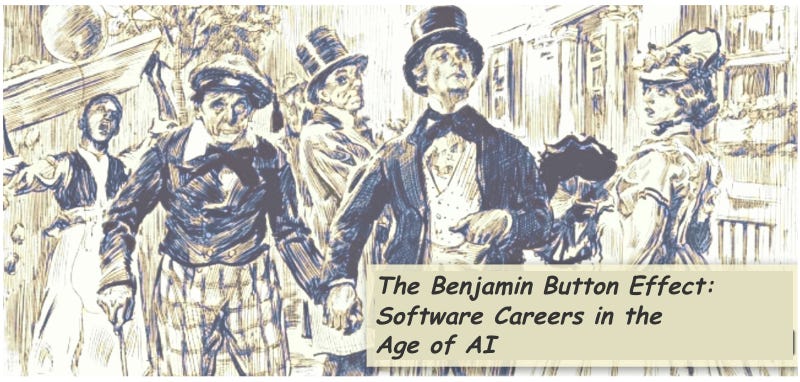
Source: https://etc.usf.edu/lit2go/224/tales-of-the-jazz-age/5770/the-curious-case-of-benjamin-button/
Introduction
My career advanced, but my proximity to the code faded. At Peloton, I worked across backend and device software teams, reviewing roadmaps, design documents, and architectural plans as we tried to untangle a monolith into microservices. My calendar filled quickly with design reviews, mentoring sessions, and cross functional discussions. Writing production code was no longer the default. When I wanted to stay close to the work, I paired with engineers to triage issues or explore a feature. When I wanted to test an idea, I worked with a junior engineer to build a prototype before taking it further. It was not the same satisfaction as sustained coding, but it kept me grounded in the realities of the system.
Over the last eighteen months, that balance has shifted in a way I did not anticipate. Large language models and coding agents have changed how quickly one can understand a codebase, build a prototype, or move through large parts of the software development lifecycle. Work that once required coordination, context, and time now compresses into hours or minutes. I have been tempted to write about this shift in the most obvious way, using AI to generate a polished take and share it publicly. Instead, I kept returning to my own experience and the quiet dissonance it created.
It reminds me of F. Scott Fitzgerald’s The Curious Case of Benjamin Button. In the original text, the protagonist is born with the physical infirmities and cynicism of a seventy-year-old man, completely out of sync with his nursery. But as he ages, he grows physically younger, shedding his cane and gray hair to eventually dominate Harvard football and storm through the business world with a terrifying mix of youthful energy and old-world experience. I am living that metaphor. AI hasn’t just made me faster; it is reversing my professional age, taking me from a reviewer of code back to a builder of worlds. It’s an apt parallel for the senior developer in the age of AI, not because experience disappears, but because it no longer looks like experience used to look.
The Harvard Effect
At Harvard, Benjamin dominates the football field not because he is young, but because he brings the physical toughness and emotional resolve of a much older man into a game played by boys still learning its limits. As he grows younger, life becomes easier in visible, almost unfair ways. The advantage is real, but it comes from a mismatch of eras rather than ability.
A similar mismatch is emerging for experienced developers working with AI. With years of judgment and architectural intuition, and an AI that can absorb context, generate code, and execute repetitive work without fatigue, senior engineers can remain deeply hands-on. They are no longer forced to trade coding for coordination. AI makes it possible to move faster than teams once could, not by replacing experience, but by amplifying it. Last year, I built several prototypes on my own, generating thousands of lines of code with the help of a coding agent, without relying on other engineers the way I once had to. Some of those prototypes were eventually productized. Like Benjamin on the field, the advantage felt undeniable and, at times, uncomfortable, because it disrupted expectations the system had long been built around.
Roscoe’s Reaction
Roscoe Button resents his father’s reverse aging not because it fails to work, but because it feels wrong. It disrupts the expected order of family life. Watching his father grow younger while he himself ages makes the structure they once relied on feel inefficient, even absurd.
A similar discomfort is emerging in software development. An experienced developer using AI can generate a complex solution in minutes. The competence is real, but the path to it violates long-held expectations about struggle, sequencing, and proof of work. Traditionally, a software career moves from junior to senior, and eventually toward management or a principal role. AI breaks that linear progression. It allows developers to arrive at working solutions before producing design documents, specifications, or long deliberation.
This reversal unsettles parts of the industry. Some see it as sloppy or unserious, especially as low-quality examples gain visibility and shape public perception. But speed and accessibility do not erase the difference between a prototype and a product. AI makes it easier to sketch ideas and explore possibilities, but it does not remove the need for judgment, rigor, or sustained ownership. In practice, it accelerates the software development cycle rather than replacing it.
This shift is already visible beyond engineering. Product managers increasingly use prototypes to test ideas and build conviction before formal requirements ever exist. For those anchored to older workflows, this can feel undignified or improper, as though the work must be hidden to preserve the appearance of tradition. Like Roscoe, the objection is less about effectiveness and more about a discomfort with outcomes arriving out of order.
Conclusion
Benjamin Button was a living anachronism because his internal clock put him at odds with the external world. Today senior developers using AI are creating that same friction. We have become technological anachronisms who carry the heavy wisdom of the past while moving with a velocity that was supposed to belong to the young. Our current workplace structures are designed for linear careers and have not yet learned how to accommodate this. The industry still expects seniors to manage and juniors to build. But the future belongs to those who can do both. The goal now is not to fix the timeline. We must ensure that in our rush to build faster we do not lose the wisdom that tells us what to build.